What is OMOP?

Caroline Morton
&
Steph Jones

November 17, 2026
This is the first of two posts on OMOP and FHIR, two standards that address different parts of the challenge of making healthcare data useful. In this post we look at the problem they are trying to solve and at OMOP, and in the second post we look at FHIR.
Why is healthcare data so hard to use?
Each interaction between a patient and a healthcare professional generates an extraordinary amount of data. Every appointment, diagnosis, prescription, blood test and hospital admission generates records about a patient and their care. The systems producing these records are designed primarily to help professionals care for patients and move patients through the system, not to help analysts make sense of the data retrospectively.
Just booking one hospital appointment can create multiple records: the patient, clinic, clinician, scheduled time and subsequent cancellations or rearrangements, and that is just one appointment before any diagnosis or treatment. Making healthcare data useful often means distilling this vast amount of data into something more meaningful, and this process should not be underestimated as it is a substantial engineering undertaking.

There is a second problem: often this information lives in different systems. A patient might visit a GP who is using EMIS Web or SystmOne, attend a hospital which is using Epic or Oracle Health, and collect a prescription from a pharmacy using Pharmacy Manager or ProScript Connect. Those systems have different database structures and may represent the same clinical information differently. A heart attack might appear as the words “myocardial infarction”, a SNOMED CT code or a local code. Clinical terminology standards help with meaning, but they do not by themselves solve the exchange of data or the difficulties in analysing this data.
The consequences of this go beyond technical inconvenience, because at an individual level a GP and a hospital may hold different pieces of information about the same patient. A hospital clinician might not have a complete picture of the medicines prescribed by the GP, or a GP might not receive timely information about changes made during a hospital admission. When information is missing, delayed or misunderstood, clinicians may make decisions without the full picture, potentially leading to duplicated tests, medication errors or avoidable harm.
What are the opportunities?
If we can reliably bring together information from GP practices, hospitals, pharmacies and laboratories, there is an enormous opportunity. Researchers could identify patients who might be eligible for clinical trials, helping more people access experimental treatments and making recruitment faster and more representative. Scientists could study how medicines perform in the real world, across millions of patients rather than only those enrolled in clinical trials. Healthcare organisations could identify patterns in disease, predict demand for services and uncover inequalities in care. And as AI becomes increasingly integrated into healthcare, access to reliable, meaningful data could help develop tools that support earlier diagnosis, more personalised treatments and better clinical decisions.
Much of this information already exists, so the challenge is making it accessible, consistent and meaningful across different systems, while protecting patient privacy and ensuring it is used appropriately.
The role of standards
Healthcare isn’t the first industry to face the challenge of making different systems work together. From barcodes in supermarkets to postcodes in postal services, standards provide a common language that allows information to be understood and exchanged, even when the systems behind it are completely different.
Interoperability doesn’t require everyone to build the same thing, but it does require agreement about how different things work together. In healthcare, two important standards have emerged to address different parts of this challenge: OMOP and FHIR.
OMOP (the Observational Medical Outcomes Partnership Common Data Model) gives researchers a consistent way to organise healthcare data for analysis. FHIR (Fast Healthcare Interoperability Resources) gives applications a common way to represent and exchange healthcare information.
Although OMOP and FHIR were developed with different purposes in mind, their uses are not mutually exclusive. FHIR can support research, just as OMOP can support applications, and what matters is how the data needs to be used.
What does this look like for a laboratory result?
Consider a laboratory result recorded during a hospital visit. If a new application needs to retrieve that result, a FHIR interface might expose it as an Observation resource. If researchers want to compare laboratory results across many hospitals over several years, the relevant information might instead be transformed into OMOP’s MEASUREMENT table. The same clinical event can therefore have different useful representations depending on the question being asked.
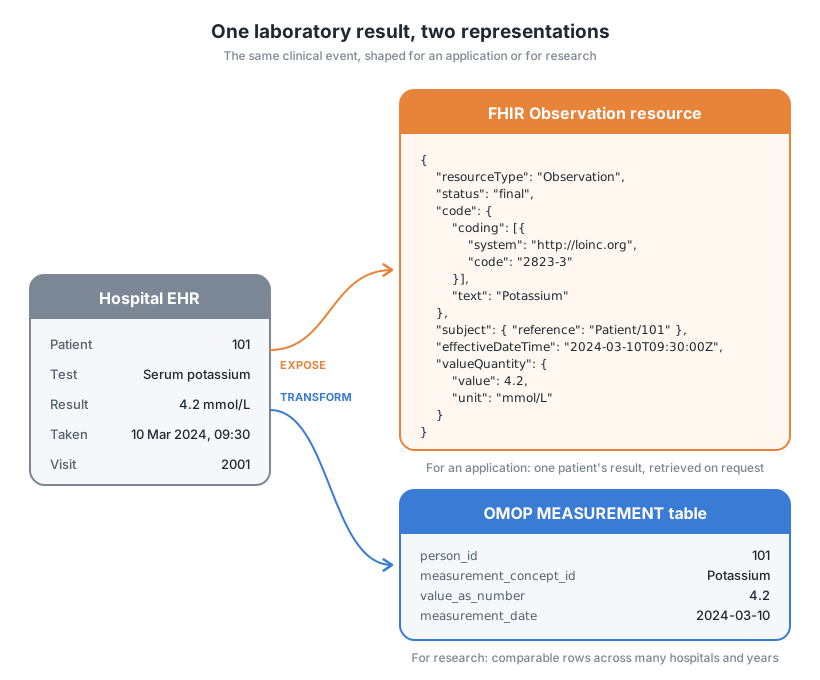
Neither standard requires an organisation to abandon its original electronic health record. Both sit alongside existing systems, although adopting either involves substantial technical and organisational work, including understanding where information came from, what it means and who is allowed to use it.
Where did OMOP come from?
OMOP began in the United States in 2008 as a public–private research partnership focused on medicine safety. Could the enormous quantities of routinely collected healthcare data help identify risks associated with treatments? The difficulty was that records sat in databases with different structures and coding conventions.
The partnership developed a Common Data Model: a standardised relational structure into which source data could be transformed. Analyses could then be reused more easily across participating databases. After the original partnership ended, its work continued through the Observational Health Data Sciences and Informatics community, OHDSI (pronounced “Odyssey”).
The OHDSI community
OHDSI is an international open-science community of researchers, clinicians, data scientists and engineers. Its 5,386 global collaborators develop tools, improve the OMOP model and collaborate on observational research. Its public symposium showcases, open documentation and community meetings make it unusually easy to see the work in progress. The aim is to produce reliable, reproducible evidence from routine care rather than simply to collect data.
Understanding the OMOP data model
OMOP is a collection of related tables, not a single spreadsheet. PERSON represents individuals; VISIT_OCCURRENCE represents encounters; CONDITION_OCCURRENCE represents conditions; DRUG_EXPOSURE represents medicines; and MEASUREMENT represents laboratory tests and vital signs. These are examples, not a complete list of tables.
A person identifier connects many records to the same individual. Hospitals with very different source systems can transform relevant information into these shared structures through an extract, transform and load (ETL) process. They also map source codes to standard concepts. This is substantial engineering work, and the model does not repair inaccurate or missing source information.
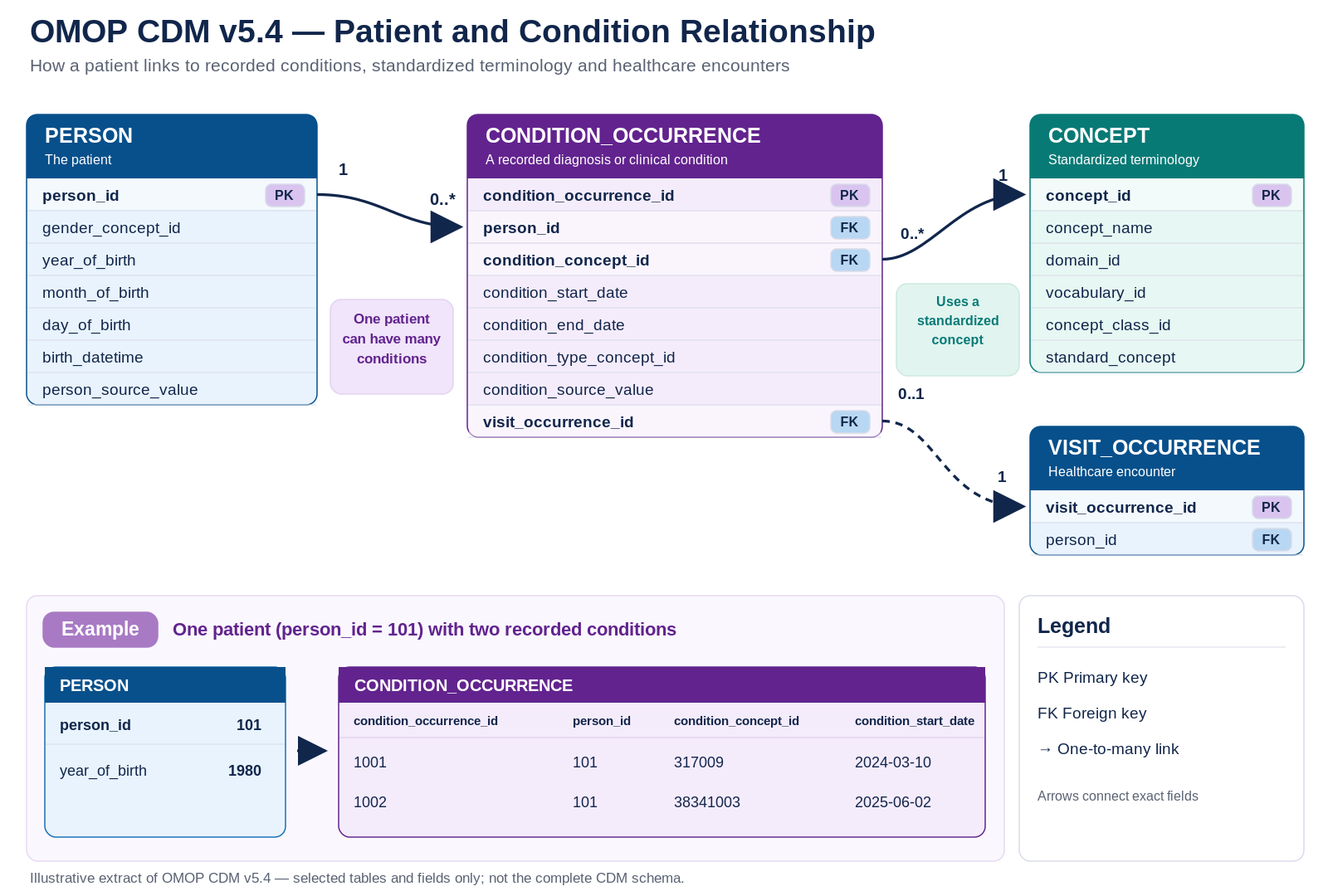
Figure 1. Simplified OMOP relationships (illustrative, not a complete schema).
What does transformation actually involve?
Suppose one hospital records blood pressure in a table called VITALS and another stores it in a table called CLINICAL_OBSERVATIONS. The first task is to identify which fields really represent blood pressure, what units they use, and how each record connects to a patient and an encounter. Data engineers then map those fields into the relevant OMOP columns and standard concepts.

The transformation involves more than renaming columns, because a source system might contain cancelled tests, duplicate results or measurements whose units are unclear. Some information may be held only in clinical notes. A team must decide how to handle those cases, document its decisions and test the resulting dataset. OHDSI publishes tools to support quality assessment, but responsibility for understanding the data remains with the people building and using it.
This is also why the community matters, because if different teams publish their methods and share lessons, later implementations can build on that experience instead of starting from scratch.
OMOP in practice: three examples from 2026
The 2026 OHDSI Global Symposium provides concrete examples of what researchers can investigate using the OMOP ecosystem. These are research presentations, not evidence that OMOP alone produced clinical improvements.
1. Comparing heart failure treatments
Researchers presented a real-world comparison of sacubitril/valsartan and angiotensin receptor blockers (ARBs) in older patients, examining worsening heart failure and acute kidney injury. This is the kind of comparative effectiveness and safety question that routinely collected records can help investigate. Standardisation supports comparable analysis, although careful study design remains essential.
2. Understanding antibiotic use across Europe
A DARWIN EU multi-database study examined antibiotic use using the WHO AWaRe classification. Participating countries do not necessarily use the same electronic health records or coding systems. OMOP helps make analyses comparable across databases while allowing data to remain with the organisations that hold it. The clinical motivation is antimicrobial stewardship: understanding patterns of antibiotic use.
3. Following patients with chronic lung disease
An international OHDSI network study investigated the clinical journeys of people with chronic pulmonary conditions. A patient journey spans more than one encounter: diagnoses, investigations, medicines and hospital admissions can be examined over time. OMOP offers a common structure for studying those sequences across different settings, while the completeness of each source still matters.
Together these examples show three research applications: comparing treatments, monitoring prescribing and describing long-term care journeys. OMOP does not answer the research question itself, but it provides infrastructure that makes well-designed questions easier to investigate across datasets.
Enabler of research
OMOP is valuable because it makes it more feasible to apply common methods to those questions across participating datasets. It does not eliminate differences between patient populations, recording practices or healthcare systems, and those differences remain important when researchers interpret their findings, which is why a common data model is best understood as an enabler of research, rather than a guarantee of comparable or unbiased results.
In the next post we turn to FHIR, which grew out of a different ambition: making it simpler for applications to exchange healthcare information.
Further reading
- What is FHIR? - the second part of this series, covering FHIR
- An Introduction to Electronic Health Records - the systems that source data comes from
- SNOMED and friends - the clinical terminologies that get mapped to OMOP standard concepts
- Clinic to Code to Care - follows information from clinic through to research, including OMOP and dbt
- What is a Codelist? - how researchers define the clinical concepts they are interested in
- The Book of OHDSI - the OHDSI community’s own introduction to OMOP and its tools
Enjoyed this? Subscribe to my newsletter.
I write about open science, research code, and building better tools for researchers.


